

Reviewed and Verified by Hari Babu, Associate Director, Digital Supply Chain & Logistics
Warehouse execution is not one-size-fits-all. Some organizations require deep automation and optimization at large fulfillment hubs, while others prioritize speed, usability, and fast deployment across regional or satellite warehouses. Choosing between SAP Extended Warehouse Management (SAP EWM) and SAP Logistics Management (SAP LGM) depends on order volume, operational complexity, and scaling strategy.
This blog explains how SAP EWM and SAP LGM are applied across different warehouse execution scenarios and how enterprises design a right-sized warehouse architecture using both platforms.
- Warehouse Execution Across the SAP Logistics Portfolio
- SAP Logistics Management: Smarter, Faster, Visually Intelligent Warehouse Execution
- SAP Extended Warehouse Management: Advanced Automation and Optimization
- Putting the Warehouse Execution Model into Practice
- Decision Framework: When to Choose SAP LGM or SAP EWM
- How Körber Stellium Helps You Design the Right Warehouse Execution Model
Warehouse Execution Across the SAP Logistics Portfolio
Warehouse operations vary significantly based on throughput, SKU complexity, automation requirements, and network design. Lightweight tools often lack visibility and control, while enterprise-grade systems can introduce unnecessary complexity for regional operations.
SAP addresses this spectrum through two complementary warehouse execution platforms:
SAP Logistics Management (SAP LGM) for distributed, regional, and satellite warehouses
SAP Extended Warehouse Management (SAP EWM) for high-volume, highly automated warehouse hubs
Together, they enable organizations to scale warehouse execution without over-investing at every location.
SAP Logistics Management: Smarter, Faster, Visually Intelligent Warehouse Execution
SAP Logistics Management delivers warehouse execution optimized for regional and satellite locations where simplicity, visibility, and speed matter more than deep automation.
In addition to operational simplicity, SAP LGM is designed to integrate seamlessly with modern SAP ERP landscapes. Organizations running SAP S/4HANA Cloud, Private Edition or SAP S/4HANA On-Premise (2022 or higher) can leverage native API-based connectivity, including OData and SOAP services, to ensure secure and real-time synchronization between warehouse execution and ERP inventory management.
For organizations seeking the most stable and harmonized integration patterns — including advanced shipping and receiving processes, SAP recommends aligning with SAP S/4HANA 2023 FPS03 (February 2025) or later releases. These versions provide enhanced integration maturity and optimized connectivity with SAP Logistics Management.
Core Warehouse Capabilities in SAP LGM
- Interactive 3D warehouse layout for visual warehouse intelligence
- Real-time inventory visibility across distributed nodes
- Mobile-first warehouse execution through native iOS and Android apps
- Automated goods receipt, picking, packing, and shipping workflows
- Embedded AI assistance (SAP Joule) to reduce training effort and errors
Best suited for:
- Regional distribution centers handling approximately 200–500 orders per day
- Growing e-commerce and omnichannel operations
- 3PLs and satellite warehouses
- Organizations operating 1–10 warehouse locations
Effective warehouse execution starts with visibility into physical layout and inventory flow, which sets the foundation for automation and operational scale.
The Gamechanger: 3D Warehouse Visualization
See Your Warehouse Like Never Before — Interactive 3D Visualization

SAP LGM introduces an interactive, editable 3D warehouse layout that fundamentally changes how supervisors and managers understand warehouse operations. The layout is dynamically generated from live warehouse data, allowing teams to zoom, rotate, pan, and view the warehouse from predefined camera angles as if they were standing inside it.
Supervisors can search for specific bins, select them to view detailed inventory and location insights, and regenerate the 3D view whenever storage configurations or underlying data change. Rather than editing layouts manually, teams interact with a continuously updated spatial model that reflects the current state of the warehouse.
By translating operational data into a visual, spatial representation, this capability accelerates decision-making, improves operator guidance, and helps identify zone-level bottlenecks more intuitively. For plant managers, it provides immediate, high-level insight into warehouse performance without requiring deep system navigation.
Once regional warehouses are up and running with clearer visibility and simpler execution, the question becomes how well a warehouse platform holds up as volumes grow and automation ramps up.
SAP Extended Warehouse Management: Advanced Automation and Optimization
SAP Extended Warehouse Management (Basic and Advanced) supports complex warehouse environments that demand high throughput, advanced automation, and detailed inventory control.
SAP EWM covers complexity levels 3 to 5, where automation, industry-specific processes, and advanced services are essential. Many customers desire a simplified solution for level 1 and 2 warehouses — those with basic functions and minimal automation. SAP Logistics Management is designed to offer a streamlined, accessible solution for smaller warehouses or satellite locations that don’t require the full scope of EWM.
Core Warehouse Capabilities in SAP EWM
- Advanced slotting algorithms to optimize bin placement and picking velocity
- Wave planning and sophisticated picking strategies to maximize throughput
- Integration with automation hardware such as conveyors, robots, sorters, and AS/RS
- Complex inventory handling, including batch, lot, serial, and dangerous goods management
- Enterprise-grade analytics for predictive slotting, demand forecasting, and performance management
Best suited for:
Mega-fulfillment centers handling millions of orders per day
Operations managing tens of thousands of SKUs
High-volume environments requiring deep automation
Hub-and-spoke warehouse network models
Beyond layout and automation depth, user experience on the warehouse floor plays a critical role in execution speed, accuracy, and adoption.
Mobile-First Warehouse Operations and Operator Productivity
SAP LGM introduces the SAP Warehouse Logistics Mobile App, delivering a consumer-grade experience that simplifies warehouse floor operations.
Mobile-First Warehouse Execution at Your Fingertips, in Real Time
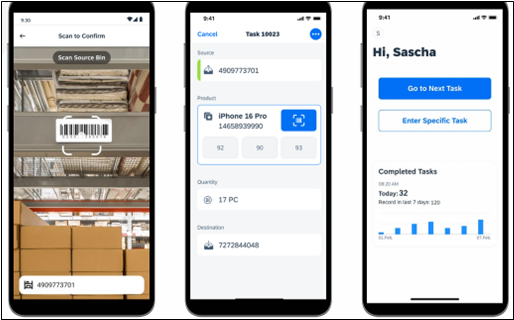
Once warehouse layout and flow are clearly understood, execution speed increasingly depends on how effectively operators interact with the system on the floor.
What warehouse operators experience with the App
- Intuitive, touchscreen-friendly interface
- Real-time data capture with immediate system updates
- Built-in guidance for each task, reducing errors
- Faster picking compared to traditional RF-based workflows
- Offline capability for environments with inconsistent connectivity
Operational benefits
- Faster onboarding without extensive RF training programs
- Reduced error rates through guided workflows
- Flexible role switching across picking, packing, and quality checks
- Real-time visibility for supervisors into floor activity
As warehouse operations mature, the way systems automate decisions becomes just as important as the features they provide.
Process Automation in Warehouse Operations
Both SAP LGM and SAP EWM automate warehouse workflows, but with different approaches and objectives.
Illustration showing where process automation can be applied:
Rule-Based Execution (LGM) and Algorithm-Driven Optimization (EWM)
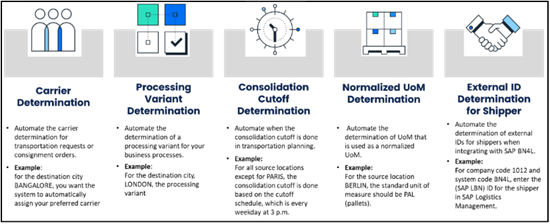
As execution scales, consistency and decision automation become critical. Process automation governs how tasks are sequenced, prioritized, and adjusted as conditions change across the warehouse.
SAP LGM: Rule-Based Warehouse Automation and Execution
- Rule-based execution logic is defined once and reused consistently
- Sequential task execution for predictable workflows
- Reduced manual decision-making
- Ideal for standardized, repeatable warehouse operations
SAP EWM: Algorithm-Driven Warehouse Automation and Optimization
- Algorithm-driven slotting and task optimization
- Wave planning and dynamic task sequencing
- Predictive inventory positioning based on demand patterns
- Designed for high-volume, complex warehouse environments
In practice, most enterprises operate a mix of warehouse types rather than a single, uniform model.
Putting the Warehouse Execution Model into Practice
Real-World Fit Case: Primary Distribution/ Mega Hubs (Tier 1) and Regional Distribution Centers (Tier 2)
In real-world environments, enterprises rarely operate a single type of warehouse. Most manage a mix of high-volume hubs and regional distribution centers, each with different execution requirements.
Operational context:
An enterprise operates two mega-hubs responsible for complex consolidation and high-throughput fulfillment, alongside eight regional warehouses handling standard picking, packing, and shipping. The objective is to maintain unified visibility and control while avoiding unnecessary complexity and cost at regional sites.
Execution model applied:
The organization adopts a tiered warehouse execution model, aligning platform capability with operational needs.
Primary Distribution Hubs (Tier 1): SAP Extended Warehouse Management (Advanced) is deployed to support high volumes, advanced slotting, wave planning, and automation integration. This enables throughput optimization and maximizes the return on automation investments.
Regional Distribution Centers (Tier 2): SAP Logistics Management is deployed to provide fast go-live, mobile-first execution, visual warehouse intelligence, and standardized automation without the overhead of a full EWM rollout.
Outcome:
This approach delivers a balanced warehouse network where advanced automation is applied where it creates the most value, while regional sites benefit from simplicity, speed, and visibility. The enterprise gains a single operational view across all locations, lower total cost of ownership, and the flexibility to scale or rebalance warehouse roles as business needs evolve.
Decision Framework: When to Choose SAP LGM or SAP EWM
Selecting the right warehouse execution platform is less about choosing a single system and more about aligning execution capability with operational reality. Order volumes, automation requirements, network design, and time-to-value all influence whether SAP LGM, SAP EWM, or a combination of both delivers the best outcome. The following guidance helps clarify where each platform fits best.
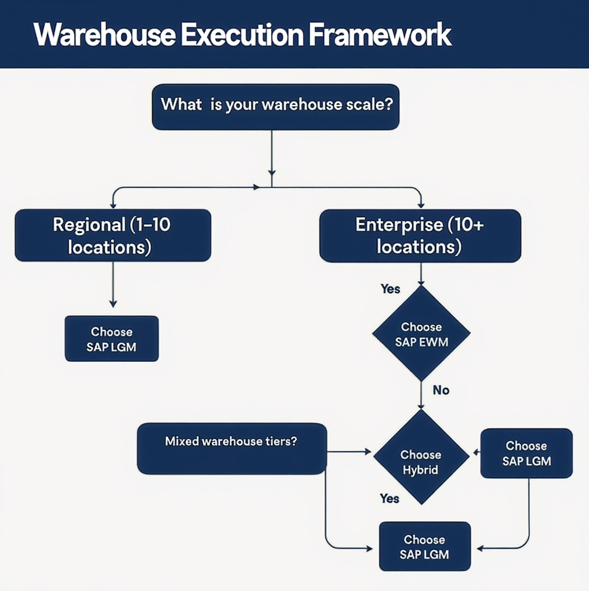
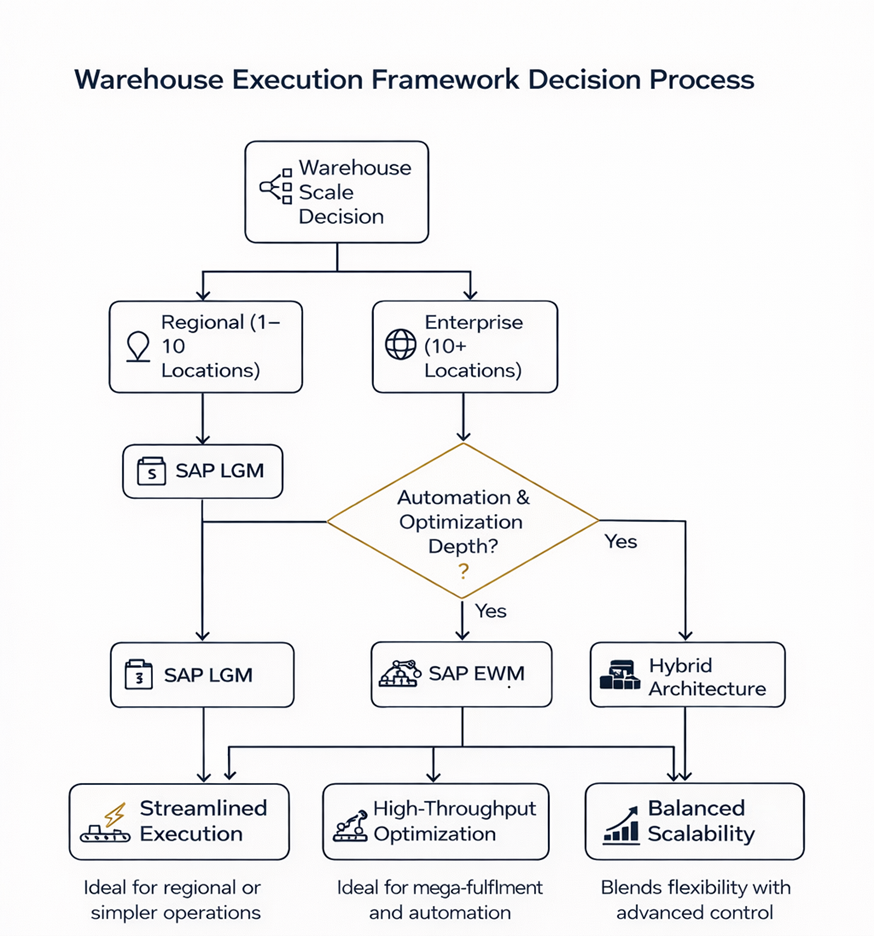
Choose SAP Logistics Management if
- Warehouses with low-order volumes need a unified execution platform, but advanced slotting and optimization are not required.
- Warehouse operations are distributed across 1–10 regional or satellite locations requiring centralized visibility without heavy customization.
- SKU complexity is manageable, with standard inventory handling methods and minimal regulatory requirements.
- Fast deployment is critical; pilot projects at small sites can go live in 2 to 4 weeks, mid-size or single-site rollouts typically take 2 to 3 months, and multi-site or integration-heavy deployments range from 3 to 6 plus months, enabling measurable results quickly.
- Mobile-first usability is important for warehouse operators and supervisors working on the floor.
- A subscription-based SaaS model aligns better with operational budgets than large upfront infrastructure investments.
Ideal for: Growing e-commerce businesses, 3PL providers, regional retail distribution, perishable goods operations, and satellite warehouses.
Choose SAP EWM (Basic or Advanced) if
- Warehouse with medium and high order volumes, and throughput optimization becomes critical.
- Automation technologies such as conveyors, robotics, or AS/RS systems are part of the warehouse strategy.
- Complex inventory handling is required, including batch, lot, serial tracking, or regulated goods management.
- SKU complexity is high, often involving tens of thousands of SKUs with dynamic slotting and advanced picking strategies.
- Centralized warehouse orchestration is needed within hub-and-spoke or high-volume network models.
- Longer implementation timelines of 6–12 months are acceptable to support automation and throughput ROI.
Ideal for: Mega-fulfillment hubs, pharmaceutical and regulated industries, automation-intensive facilities, and centralized high-volume distribution networks.
Consider a Hybrid Approach if:
- You operate a mix of high-volume primary hubs and regional or satellite warehouses with different complexity levels.
- You want to deploy SAP LGM quickly across distributed locations while reserving SAP EWM for hubs that require deep optimization.
- Your modernization strategy is phased, beginning with faster regional improvements before investing in advanced automation.
- You require unified visibility across warehouse tiers while aligning execution depth with operational complexity.
This approach represents a deliberate architectural strategy rather than an upgrade path. SAP positions SAP Logistics Management and SAP Extended Warehouse Management to coexist within the same enterprise landscape, enabling organizations to apply the right level of execution capability to each warehouse tier.
Ideal for: Enterprise-scale operations, multi-tier supply chains, phased digital transformation programs, and organizations balancing cost control with automation investment.
How Körber Stellium Helps You Design the Right Warehouse Execution Model
Designing the right warehouse architecture requires aligning execution depth with operational reality. By bringing together Körber’s advanced automation and digital supply chain technology with Stellium’s deep SAP logistics expertise, Körber Stellium helps organizations build scalable, future-ready warehouse execution models using SAP Logistics Management and SAP Extended Warehouse Management.
Connect with Körber Stellium’s experts to modernize your warehouse operations with the right balance of automation, visibility, and execution speed.