
Reviewed and Verified by Hari Babu, Associate Director, Digital Supply Chain & Logistics
Modern supply chains demand speed, visibility, and collaboration, without the cost and complexity of heavyweight logistics systems. SAP Logistics Management (SAP LGM) is a cloud-first logistics execution platform designed for growing businesses and large enterprises operating regional or satellite logistics units.
By unifying warehouse execution, transportation management, and carrier network collaboration into a single platform, SAP LGM enables organizations to execute logistics processes efficiently across distributed, multi-tier supply chain networks, while maintaining seamless integration with their ERP landscape.
This article covers the scope of :
Why Logistics Execution Needs a Lighter, Faster Model
What Is SAP Logistics Management (SAP LGM)?
Core Capabilities of SAP Logistics Management (LGM)
Who Is SAP Logistics Management Built For?
SAP LGM Commercial Model Designed for Faster ROI
How Stellium Enables SAP Logistics Management Success
Why Logistics Execution Needs a Lighter, Faster Model
As fulfillment models evolve, spanning e-commerce, retail, direct delivery, and regional distribution, logistics operations can no longer function in silos. Traditional enterprise logistics solutions often introduce high CAPEX, long implementation timelines, and operational overhead that are not required for every warehouse or distribution node.
Many organizations are caught between two extremes: spreadsheet-driven local warehouses that lack visibility, and enterprise-grade systems that are too complex for regional operations. SAP Logistics Management addresses this gap by offering a right-sized logistics execution layer, delivering control, visibility, and collaboration without the functional and operational weight of SAP EWM or SAP TM where that depth is not required.
What Is SAP Logistics Management (SAP LGM)?
SAP Logistics Management is a fully cloud-hosted, unified logistics execution platform that integrates:
- Warehouse logistics
- Transportation and freight execution
- Network logistics and carrier collaboration
into a single solution. It enables organizations to manage inbound, outbound, and network logistics processes with real-time visibility across distributed logistics nodes, supporting both centralized oversight and localized execution.
How SAP LGM Fills the Market Gap
In today’s logistics landscape, businesses operate across very different levels of scale and complexity. Many organizations fall into a gap between two extremes:
Local, spreadsheet-driven operations with limited visibility and heavy manual effort
Enterprise-grade platforms like SAP EWM and SAP TM introduce cost, complexity, and long implementation cycles.SAP Logistics Management (SAP LGM) is designed to fill this gap.
The SAP Logistics Portfolio — Where LGM Delivers Maximum Value
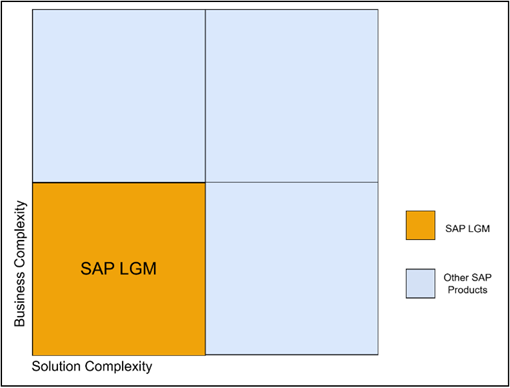
The matrix illustrates:
- Spreadsheet-based operations: Fragmented systems, no real-time visibility, high manual effort, limited scalability
- SAP LGM sweet spot: Unified cloud platform, rapid deployment, intuitive UX, easy scale across regional nodes
- SAP EWM / SAP TM: Advanced automation, deep customization, and optimization for large hubs and global networks
SAP LGM is built for organizations that have outgrown spreadsheets but don’t need the complexity of SAP EWM or SAP TM, combining warehouse execution, transportation, and carrier collaboration in one streamlined platform.
Core Capabilities of SAP Logistics Management (LGM)
SAP Logistics Management delivers logistics execution through three integrated capability layers. Together, these capabilities enable faster execution, simpler adoption, and seamless connectivity across distributed logistics operations.
1. Functional Capabilities
What SAP LGM does: These capabilities handle the day-to-day execution of logistics operations.
Warehouse Execution: Smarter, Faster, Visually Intelligent
Beyond picking, packing, and receiving, SAP LGM introduces:
- Interactive 3D Warehouse Layout – Zoom, rotate, pan, and explore your warehouse as if you’re standing inside it. Search for specific bins, click for detailed insights, and regenerate views when storage data changes. This transforms abstract inventory data into spatial intelligence.
- Real-time inventory visibility across distributed nodes
- Mobile warehouse execution -SAP Warehouse Logistics Mobile App delivers 15% faster picking with an intuitive, native iOS/Android experience
- Goods receipt, picking, packing, and shipping automation
Designed for low-to-medium complexity warehouses without the overhead of SAP EWM Advanced.
Stock Reconciliation & Inventory Synchronization
- Side-by-side stock comparison between SAP Logistics Management (LGM) and SAP S/4HANA
- Immediate visibility into inventory gaps and quantity discrepancies between warehouse execution and ERP records
- Real-time identification of variances across warehouse, product, plant, storage location, and stock type
- Flexible filtering to isolate only discrepant stock records requiring attention
- Transaction-level synchronization between LGM warehouse execution and ERP inventory management
- One-click correction workflows that generate compliant inventory and material documents in SAP S/4HANA
- Full audit trails to support financial transparency and regulatory compliance
- Exception highlighting to quickly identify root causes of reconciliation mismatches
Enables continuous inventory alignment between warehouse execution and ERP systems, ensuring real-time visibility, financial accuracy, and operational control across distributed logistics networks. This capability is supported by SAP’s Reconcile Stock application, which helps business process specialists quickly identify and correct inventory discrepancies between SAP LGM and SAP S/4HANA.
Transportation & Freight Execution
- Shipment planning and dispatch
- Carrier selection and freight settlement
- Dock appointment and gate management
- End-to-end shipment tracking
Ensures smooth coordination between the warehouse and outbound logistics without requiring SAP TM.
Network Logistics & Carrier Collaboration
- Digital freight tendering and RFQs
- Collaboration with carriers, freight forwarders, and 3PLs
- Real-time confirmations and milestone updates
- Native integration with SAP Business Network for Logistics (BN4L)
- Enables network-centric logistics execution across multi-tier supply chains.
Together, these capabilities enable seamless, network-centric logistics execution across multi-tier supply chains with real-time collaboration and visibility.
2. Intelligent Capabilities
How users interact with SAP LGM: These capabilities simplify execution and decision-making.
- Zero-Learning-Curve Logistics Intelligence (Powered by SAP Joule)
- Natural-language interaction for logistics tasks
- Retrieve insights and trigger actions without navigating multiple screens
- Real-time visibility across warehouse, transportation, and network operations
- Reduced training effort and faster user adoption
SAP Joule acts as embedded logistics intelligence, not a separate AI tool—helping teams work faster with minimal learning curve.
3. Platform & Integration Capabilities
How SAP LGM connects and scales: These capabilities ensure SAP LGM fits seamlessly into existing enterprise landscapes.
- Cloud-Native Architecture
- Fully cloud-hosted SaaS solution
- Rapid deployment and continuous updates
- Modular rollout across regional or satellite locations
Supports scalable logistics execution without heavy infrastructure.
ERP & Network Integration
- API-ready integration with SAP S/4HANA and Oracle ERP systems
- Cloud integration via SAP Integration Suite on SAP BTP
- Out-of-the-box connectivity with SAP Cloud ERP, Private Edition
- Seamless collaboration through SAP Business Network for Logistics
- Enables distributed deployment while maintaining centralized visibility and control.
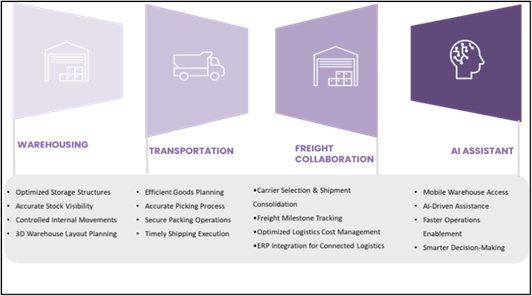
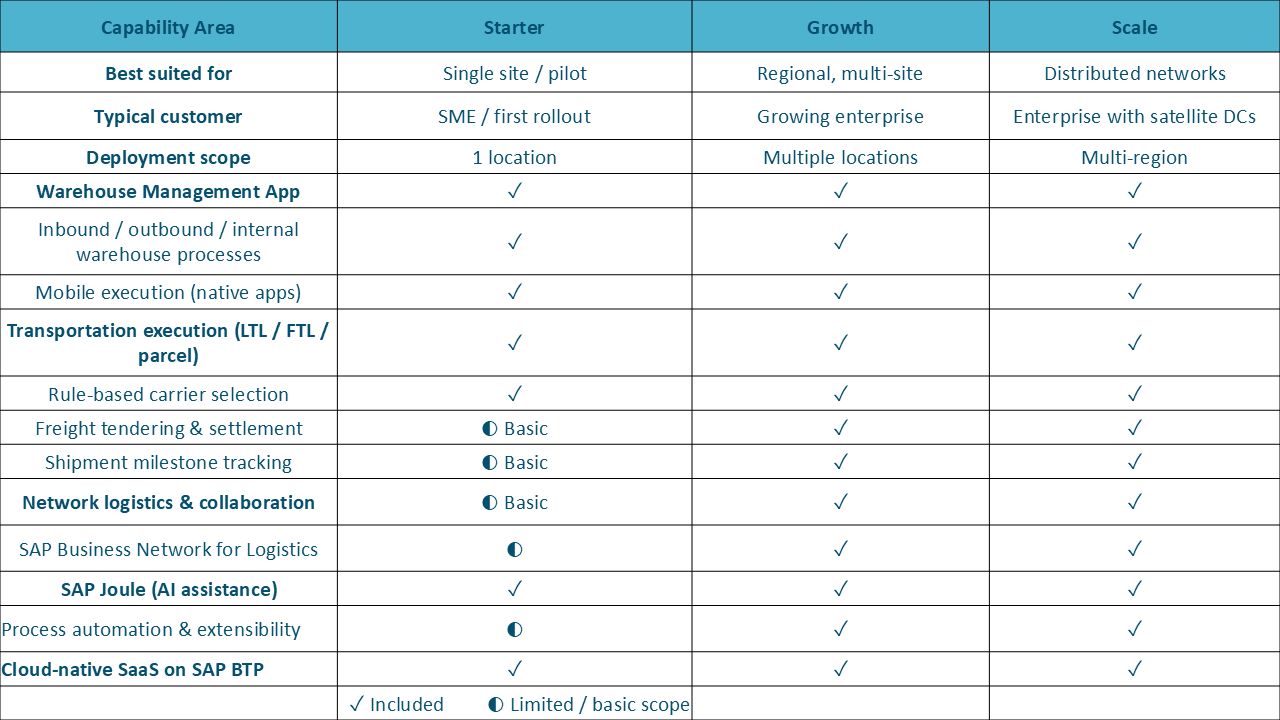
Here is a summary version of the capabilities of SAP Logistics Management:
Who Is SAP Logistics Management Built For?
- Small and mid-sized enterprises scaling logistics operations
- Large enterprises managing regional, satellite, or lightweight distribution centers
- Organizations seeking lower CAPEX and faster logistics modernization
- Businesses that require warehouse + transportation + network collaboration in one platform
Comparing SAP LGM, EWM, and TM: Roles in the Supply Chain
SAP Logistics Management complements the SAP logistics portfolio by serving scenarios where:
- Full EWM or TM functionality is not required
- Rapid deployment and ease of use are critical
- Cloud-based execution and network collaboration are priorities
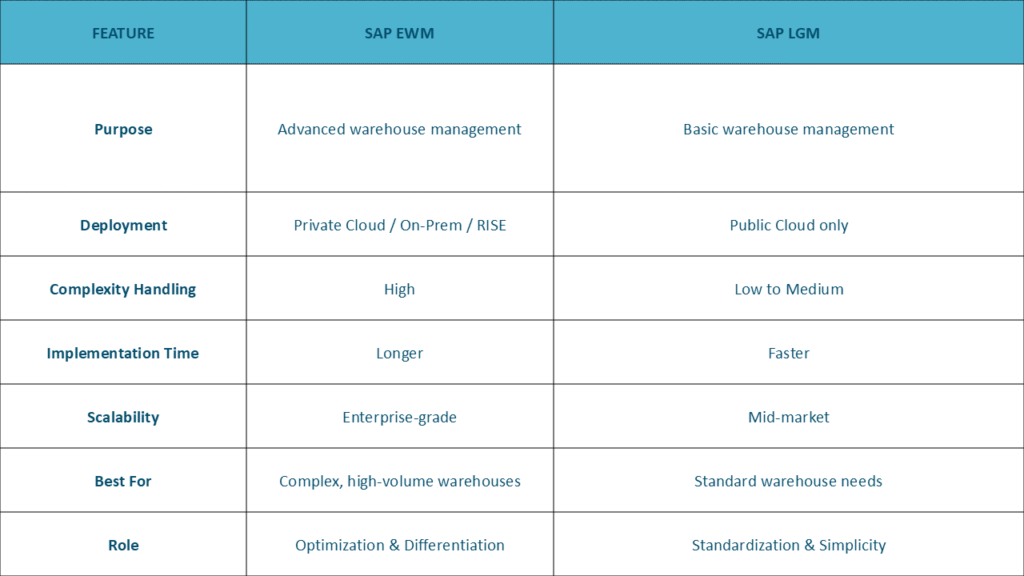
As organizations modernize their warehousing within S/4HANA, understanding the difference between SAP EWM and SAP LGM helps align the right solution to operational needs and cloud strategy.
SAP LGM vs. SAP EWM
SAP Logistics Management and SAP Transportation Management both support transportation execution. However, they serve very different operational scenarios and business objectives.
SAP LGM vs. SAP TM : When to Use Which
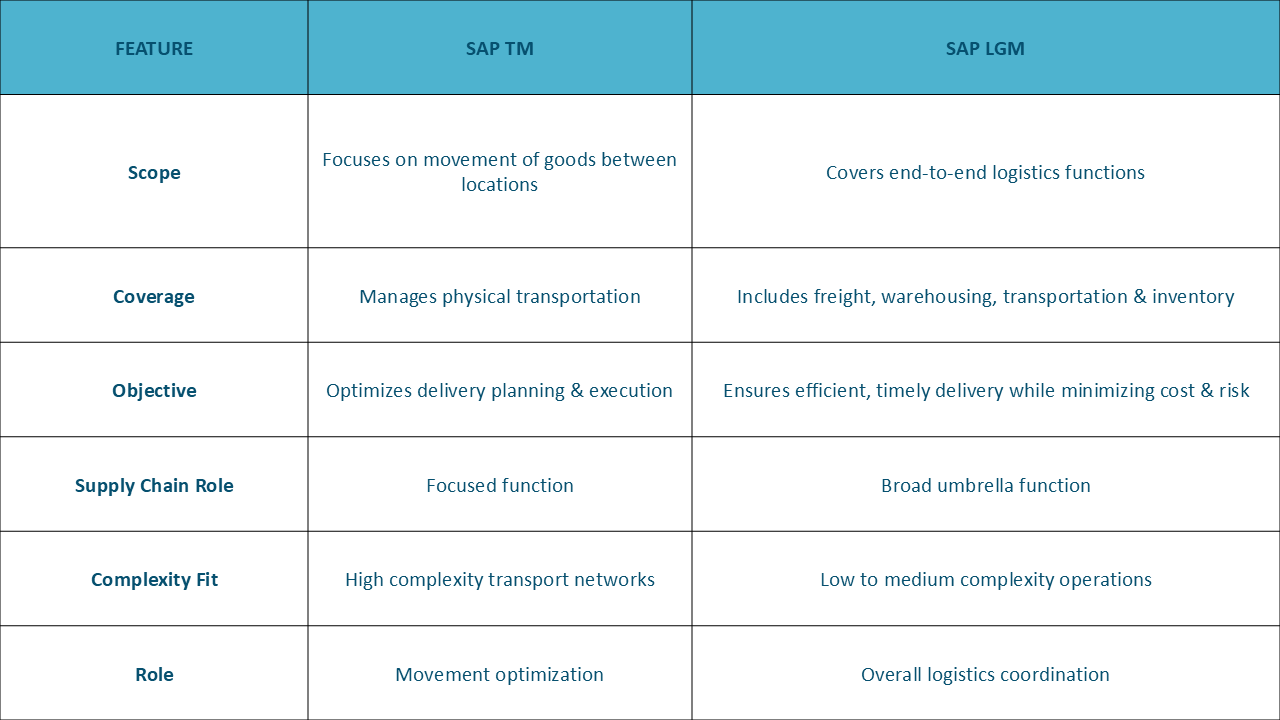
SAP LGM is designed for rapid execution in regional and distributed networks. It goes live in weeks, supports supervisors and operators, offers native mobile apps, and follows a SaaS subscription model with minimal training.
SAP TM is built for global transportation optimization. It supports complex, multi-modal networks, advanced planning and cost optimization, requires longer implementation timelines, and involves higher training and infrastructure investment.
In short:
Choose SAP LGM for speed, simplicity, and regional execution.
Choose SAP TM for global scale and advanced optimization.
Choose SAP EWM for complex warehouse operations requiring scale, process depth, and execution excellence.
The right choice depends on:
- Network geography: Regional or satellite (LGM) vs. global and multi-modal (TM)
- Warehouse complexity: Standard operations (LGM) vs. high-volume, complex fulfillment (EWM)
- Time-to-value: Weeks (LGM) vs. months (TM / EWM)
- Optimization depth: Operational visibility (LGM) vs. advanced cost optimization (TM) vs. advanced warehouse optimization (EWM)
Many enterprises adopt a hybrid approach, deploying SAP LGM for rapid regional execution, then extending SAP TM where global optimization is required, and SAP EWM for complex warehouse operations that require deeper process control and scalable execution. SAP LGM provides a focused logistics execution layer while allowing enterprises to reserve EWM and TM for complex, high-volume hubs, supporting a hybrid logistics architecture across multi-tier supply chains.
SAP LGM Commercial Model Designed for Faster ROI
SAP Logistics Management (LGM) is delivered as a cloud-native SaaS logistics execution offering, designed to balance functional breadth, predictable costs, and faster time-to-value for distributed logistics environments.
What Influences SAP LGM Pricing
SAP Logistics Management pricing is driven by usage and scale, including:
- Number of logistics sites
- Transaction and document volumes
- Carrier and 3PL collaboration usage
- ERP and network integration scope
- Package level selected (Starter → Growth → Scale)
Stellium helps you assess the right package and subscription tier based on your operational needs.
Illustrative Package Structure
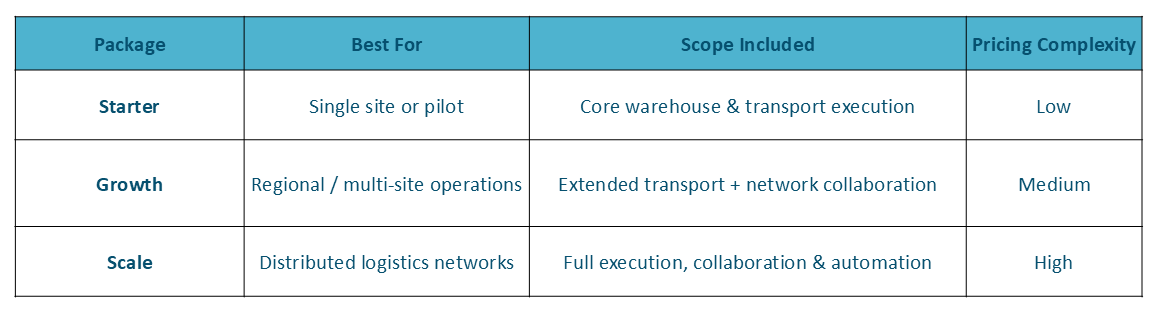
(Final pricing depends on SAP subscription tier and transaction volumes.)
Package Comparison Table
Commercial Structure
- Subscription-based licensing, procured separately from SAP S/4HANA
- Pricing is typically aligned to document or transaction volumes, enabling usage-based scalability
- Delivered without heavy infrastructure or large upfront CAPEX
This commercial model allows organizations to modernize logistics execution while maintaining cost control as volumes grow.
Value Delivered Through the Model
By combining warehouse execution, transportation dispatch, and network collaboration in a single platform, SAP LGM enables:
- Predictable operating expenses across multiple logistics sites
- Faster implementation compared to EWM Advanced or SAP TM
- Easier scale-out to regional or satellite locations
- Lower financial risk for phased or incremental deployments
- Native mobile apps enable real-time logistics execution on the shop floor
Fit Within the SAP Landscape
SAP LGM is positioned as a right-sized execution layer within the SAP logistics portfolio:
Complementing SAP EWM (Basic or Advanced) in hybrid landscapes
Replacing fragmented tools or spreadsheets at satellite sites
Supporting logistics execution where deep automation is not required
How Stellium Enables SAP Logistics Management Success
Stellium supports organizations in adopting SAP Logistics Management through:
- Use-case-driven solution alignment
- Rapid cloud implementation and integration
- Connectivity with SAP ERP, carrier networks, and SAP Business Network
- Continuous optimization and scale-up support
Key Takeaway
SAP Logistics Management combines cloud-first execution with zero-learning-curve logistics intelligence. It enables organizations to modernize logistics operations across distributed, multi-tier networks, delivering visibility, control, and collaboration without the complexity traditionally associated with enterprise logistics systems.
Ready to elevate your business to the next level? Talk to our experts today!