

Reviewed and Verified by Manoj Dey, Associate Director, Digital Supply Chain & Consulting
Modern transportation requires visibility, coordination, and control. However, the level of transportation sophistication required varies widely based on network scale, geography, and optimization goals.
This blog evaluates SAP Transportation Management (SAP TM) as the central transportation platform, with SAP Logistics Management (SAP LGM) positioned as a complementary or alternative execution layer for regional and distributed networks.
Transportation Execution Across the SAP Logistics Portfolio
Transportation execution varies widely based on network scale, geography, and decision complexity. Some organizations prioritize fast, operational control at regional distribution centers, while others require centralized planning and optimization across global, multi-modal networks.
To support these realities, SAP offers multiple transportation execution capabilities within its logistics portfolio. SAP Transportation Management (SAP TM) and SAP Logistics Management (SAP LGM) address distinct transportation needs; each is designed for different scales of operation and varying levels of execution depth.
Understanding how these solutions fit into the broader SAP logistics landscape helps organizations choose the right transportation execution model.
SAP Logistics Management vs SAP Transportation Management
While both platforms support logistics execution, they address very different operational needs and complexity levels.
Key differences at a glance:
• Execution focus: SAP LGM focuses on regional transportation execution, while SAP TM is designed for global transportation planning and optimization.
• Network complexity: SAP LGM supports regional and single-tier distribution networks, whereas SAP TM manages multi-modal global transportation networks.
• User roles: SAP LGM is primarily used by supervisors and warehouse operators, while SAP TM is used by transportation planners and logistics analysts.
• Automation model: SAP LGM relies on rule-based workflows for operational simplicity, whereas SAP TM uses advanced algorithms for route optimization and freight planning.
• Deployment model: SAP LGM can be deployed quickly for regional logistics operations, while SAP TM implementations typically require longer timelines due to planning and optimization layers.
Comparison between SAP LGM and SAP TM
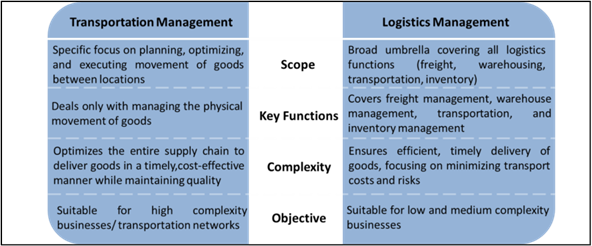
Transportation Capabilities Across SAP Logistics Management and SAP Transportation Management
Transportation execution in SAP’s logistics portfolio spans a range of network complexities. While SAP Transportation Management focuses on enterprise-scale planning and optimization, SAP Logistics Management provides streamlined transportation execution for regional and distributed logistics networks.
SAP Transportation Management: Enterprise-Grade Transportation Optimization
SAP Transportation Management is SAP’s flagship solution for end-to-end transportation planning, execution, and optimization across complex global supply chain networks.
Transportation capabilities delivered by SAP TM
- Multi-modal route planning and optimization across road, rail, air, and ocean
- Advanced carrier rate management and freight cost optimization
- Demand-driven transportation planning and network simulation
- Regulatory compliance and international shipping support
- Strategic transportation analytics and cost visibility
- Deep integration with SAP EWM and SAP ERP systems
Who Benefits Most
- Global manufacturers and high-volume shippers
- Networks with multi-country, multi-modal transportation flows
- Centralized transportation planning teams
- Enterprises targeting strategic transportation cost reduction through optimization
SAP Logistics Management: Regional Transportation Execution Without Complexity
SAP Logistics Management provides transportation execution designed for distributed and regional logistics networks where speed, usability, and operational simplicity matter more than deep optimization.
Core transportation capabilities in SAP LGM
• Shipment planning and dispatch with real-time order-to-truck visibility
• Digital carrier selection, freight RFQs, and tendering
• Dock appointment and gate scheduling functionality via integration with BN4L/EWM
• Native integration with SAP Business Network for Logistics
• Mobile-first execution for supervisors and operators
• Rule-based process automation for transportation decisions
Who Benefits Most
• Regional hubs and satellite distribution centers
• Growing e-commerce and omnichannel operations
• 3PL providers needing rapid onboarding
• Organization operating less than 10 distribution centers
Transportation Capability Comparison: SAP TM and SAP LGM
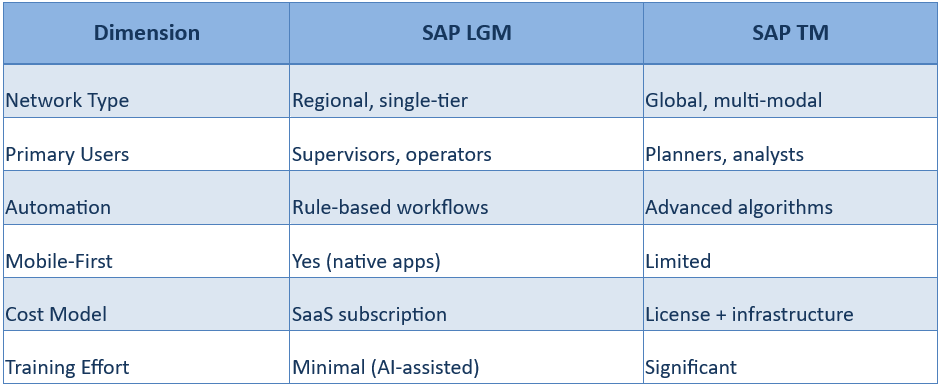
Unlike planning-heavy tools, SAP LGM introduces rule-based transportation automation that removes repetitive manual decisions.
Real-World Scenario: Applying SAP TM and SAP LGM in Practice
Rather than viewing SAP Transportation Management and SAP Logistics Management as competing tools, it is more effective to understand where each platform fits based on operational scale, planning complexity, and execution needs. The following fit cases illustrate how organizations typically apply each solution.
Regional E-commerce and Omnichannel Distribution
Operational context:
An organization operates multiple regional distribution centers serving e-commerce and retail channels. Transportation decisions are made locally, shipment volumes are moderate, and speed of execution is more critical than advanced cost optimization.
Why SAP Logistics Management fits:
- Rapid deployment enables faster time-to-value
- Mobile-first execution supports supervisors and on-floor teams
- Built-in carrier collaboration simplifies regional freight coordination
- Unified visibility across locations without centralized planning overhead
Outcome:
SAP Logistics Management provides efficient, execution-focused transportation control while avoiding the complexity and cost of enterprise-grade optimization.
Best-fit platform: SAP LGM
Global Manufacturing and Centralized Transportation Planning
Operational context:
A global manufacturer manages transportation across multiple countries and modes, with high shipment volumes and strong pressure to optimize freight costs and service levels. Planning decisions are centralized and data-driven.
Why SAP Transportation Management fits:
- Advanced optimization supports multi-modal, multi-leg routing
- Centralized planning enables consolidation and cost control
- Predictive analytics improve capacity and service planning
- Deep ERP and WMS integration to support end-to-end orchestration
Outcome:
SAP Transportation Management acts as the transportation core, delivering strategic optimization and long-term cost efficiency across complex global networks.
Best-fit platform: SAP TM
Transportation Visibility: Operational Control vs Strategic Insight
Real-time visibility is essential for both operational execution and strategic transportation decisions. SAP TM and SAP LGM surface this visibility through a shared dashboard experience, tailored to different user roles.
Real-Time Dashboard
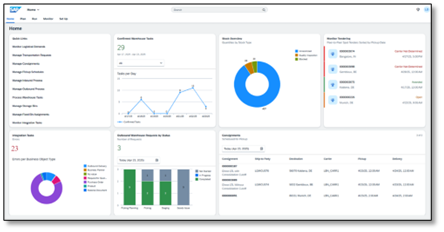
Key highlights of the real-time dashboard:
- Live view of active shipments and transportation status across the network
- Carrier performance tracking and on-time delivery monitoring
- Immediate visibility into exceptions, such as delays or cost deviations
- Role-based insights, enabling supervisors to act quickly and planners to assess network-level performance
This single-screen view enables faster response, clearer accountability, and better transportation decision-making across both regional and global operations. The real-time dashboard extends beyond transportation, providing unified visibility across warehouse execution in SAP EWM and SAP Logistics Management.
Decision Framework: When SAP TM or SAP LGM Is the Right Choice
Choose SAP LGM If:
- You operate regional or satellite distribution centers
- Fast time-to-market is critical
- User adoption speed matters
- Unified warehouse, transportation, and carrier visibility is required
- SaaS subscription pricing aligns with your budget
Choose SAP TM If:
- You manage complex, global transportation networks
- Advanced optimization drives competitive advantage
- Longer implementation timelines are acceptable
- Strategic cost reduction is a primary objective
How Körber Stellium Helps You Design the Right Transportation Execution Model
Choosing between SAP Transportation Management and SAP Logistics Management is not about selecting a single tool; it is about designing a transportation execution model that aligns with your network complexity, growth stage, and time-to-value goals.
SAP Logistics Management enables rapid modernization of regional transportation through mobile-first execution, real-time visibility, and streamlined carrier collaboration.
SAP Transportation Management serves as the transportation core for enterprises that require deep optimization, centralized planning, and global network control.
Many organizations begin with SAP Logistics Management to achieve speed and operational clarity, then extend to SAP Transportation Management as transportation volumes, geographies, and optimization requirements grow. The right choice depends on your network complexity and timeline.
Talk to Körber Stellium’s supply chain experts to design a scalable, future-ready transportation architecture.